Detailed Summary
Introduction to CLI Agents (0:00 - 1:14)
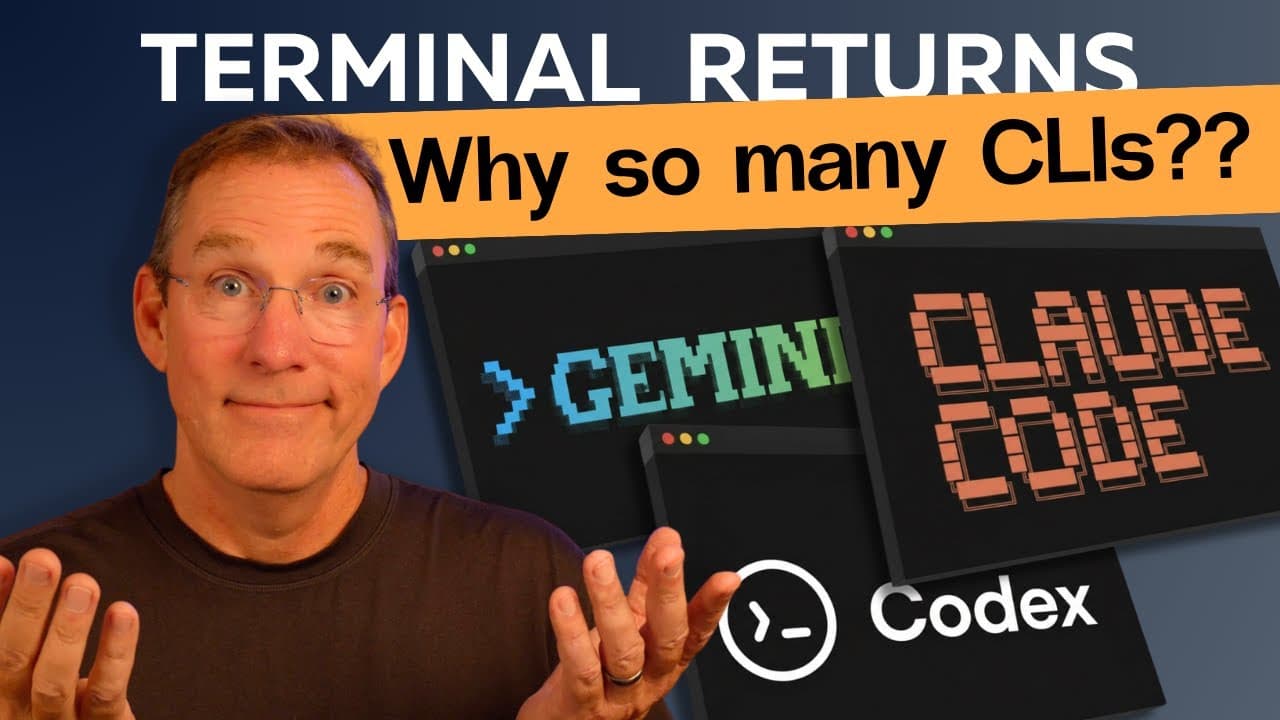
The video introduces the trend of AI companies releasing new models and products, highlighting Claude Code as a pivotal release that initiated a new race in AI. It questions why AI agents are moving to the terminal and why Command Line Interfaces (CLIs) are becoming so important. Claude Code was the first to be presented as a coding agent for the terminal, surpassing products like Cursor due to its affordability and high usage limits. Following Claude, other companies like Gemini (with Gemini CLI), OpenAI (with Codex), and Qwen (with QwenCode) also released their own coding CLIs, with Cursor eventually releasing its own as well.
Why Terminal Agents? (1:14 - 2:22)
The core reason for the shift to terminal agents is that companies are developing portable AI engines capable of deployment and execution anywhere, not just within the terminal. These agents are essentially models equipped with tools. When installed, a terminal tool like Claude Code can be called from any location in the system, gaining access to all files, allowing it to read, act on, and create new files. The tools within Claude Code enable it to perform these operations, such as creating or reading files.
The Power of the Bash Tool and Bash Agents (2:22 - 4:24)
The bash tool is crucial as it allows AI agents to execute commands directly within the terminal, making them incredibly powerful due to their system-wide accessibility. An example demonstrates Claude Code running the Codex CLI in headless mode to research user limits on the Gemini CLI, showing how one AI agent can call another. This capability gives rise to "bash agents," which can leverage numerous system tools and functionalities. For instance, Gitingest, a CLI tool, can convert large GitHub repositories into an LLM-readable format, and Claude Code, with bash access, can perform such operations. This system-level access enables the creation of a new breed of highly capable agents.
Scalekit Sponsorship (4:24 - 5:26)
Scalekit is introduced as a sponsor, offering a modular Oauth stack specifically designed for B2B AI products. Unlike legacy platforms, Scalekit is built from the ground up for multi-tenancy, sessions, and organizational hierarchies. It provides secure authentication for human users through passwordless flows, social login, or pass keys, and supports enterprise features like SSO and SCIM provisioning. Scalekit also offers a drop-in Oauth layer for MCP servers, ensuring seamless authentication for AI agents, allowing secure scaling without refactoring or rewrites.
Portability Beyond the System Level (5:26 - 6:56)
Beyond system-level access, these AI engines are portable because they can be deployed on any server, typically Linux-based, which are primarily controlled via the terminal. Claude's vision includes making it easy to deploy pre-built AI agents anywhere. A common deployment location is GitHub, where workflows can run automatically. Claude Code offers a GitHub app that can review pull requests and assist with code. By modifying GitHub workflows, users can create custom agents that perform specific tasks at scheduled times, such as an AI model monitor agent that summarizes information from websites and notifies users of new AI releases.
Claude's Agent SDK and Implementations (6:56 - 8:09)
Anthropic released the Agent SDK (formerly Claude Code SDK) to enable the creation of custom AI agents, essentially a pre-built version of Claude Code. They have integrated this technology into various products, such as Claude Code for Chrome (an embedded agent with Chrome-specific tools) and Claude for Excel. Claude Code is also available as an extension for Integrated Development Environments (IDEs). The non-interactive "P flag" or headless mode allows CLI tools to process a single request and exit, making them ideal for custom applications, scripts, and programmatic integration into workflows like CI/CD pipelines for maintaining existing applications and performing specific roles.
MCP Servers and Agent Comparisons (8:09 - 9:33)
CLI tools, including Claude Code, can be configured as MCP (Multi-Client Protocol) servers, either local or remote, and given custom tools for specialization. An example is given of Claude Code implemented as an MCP server connecting to clients via MCP, further reinforcing its portability. When comparing current options, Claude Code is considered the best agent due to its extensive features, though its underlying models can be inconsistent. Claude does not offer free credits. Gemini and QwenCode provide free usage limits. Codex and Claude Code usage is typically shared with existing subscription plans. While Codex models are good, its agent functionality is less comprehensive than Claude Code. Cursor, despite running on similar subscriptions, also lacks the feature set of Claude Code.