Detailed Summary
The video introduces the surprising trend of major AI companies like Anthropic, OpenAI, and Google developing CLI applications. It questions why this shift is occurring, given the common perception of terminals as difficult or intimidating, and sets out to explain the underlying strategic reasons.
This section acknowledges the general fear and avoidance of terminal applications among many users, including some developers, due to their perceived trickiness and potential for mistakes. It highlights the apparent contradiction of cutting-edge AI applications moving into this environment.
The video introduces Claude Code, Anthropic's popular CLI for using their models for coding. It describes the basic interaction as similar to a chatbot, where users type questions and receive answers, but notes the environment feels more difficult, harder to read, and riskier, reinforcing the initial question of "why here?"
Starting our Journey (2:20 - 3:43)
This segment begins the exploration into why billion-dollar companies are investing in terminal agents, stating explicitly that it's a strategy, not nostalgia. The first reason discussed is the low friction and ease of updating CLIs, which avoids the significant investment and complexity of building and maintaining graphical user interfaces (GUIs) in a rapidly changing AI landscape where features can become obsolete in months.
The core reason for CLIs is revealed to be the creation of "agentic loops." These are sophisticated systems of agents designed to take an objective, use tools and techniques, and progressively work through a problem to achieve a desired outcome. The video explains that model developers realized that by building these tight agentic systems around their models, they could create the best delivery system for coding, offering a direct, one-to-one relationship between the user, their context (files, problem), the model, and the coordinating agentic loop. This allows the model manufacturers to dictate the optimal way to interact with their models.
This section highlights a crucial business advantage: direct customer relationships. By offering their own CLI tools, AI companies like Anthropic can engage directly with their users, gather feedback, upsell, and understand their needs without intermediaries like third-party IDEs (e.g., Cursor). This direct channel is vital for businesses to maintain control and foster loyalty with their customer base.
The video identifies the ultimate reason for the CLI trend: building a portable AI "engine." The CLI itself is a tightly integrated piece of code that can take a problem, interact with tools and context, make changes, and return a result. This standalone engine is the "super secret sauce" because it provides a consistent, powerful core functionality that can be deployed and accessed from various interfaces, making it incredibly versatile.
Demonstrates the Claude Code CLI in action, showing how it can read files and provide definitions of an application. This illustrates the direct interaction with the core engine in its native terminal environment.
This part showcases how the Claude Code engine can be used headlessly as a tool within other scripts or applications. By calling it with a simple command (e.g., claude -p "tell me about this application"), developers can integrate its agentic capabilities into their own workflows without needing to interact with a UI, highlighting its flexibility as a programmatic component.
The video demonstrates the integration of Claude Code into an IDE like Cursor (or VS Code) via an extension. It explains that the IDE panel, while appearing native, is actually running the same Claude Code terminal engine behind the scenes, submitting questions and displaying results. This illustrates how the core engine can power a more user-friendly graphical interface.
This section shows how the Claude AI web interface (similar to ChatGPT) also leverages the same underlying Claude Code engine. When users interact with the web app's coding features, a virtual machine runs the Claude Code engine, providing results that are then displayed through the web UI. This further emphasizes the engine's versatility across different platforms.
Finally, the video illustrates Claude Code's integration into GitHub for automated code reviews and fixes on pull requests. When a user asks Claude to fix problems in a PR, the GitHub infrastructure runs the Claude Code engine to perform the task, demonstrating its deployment in a collaborative development environment.
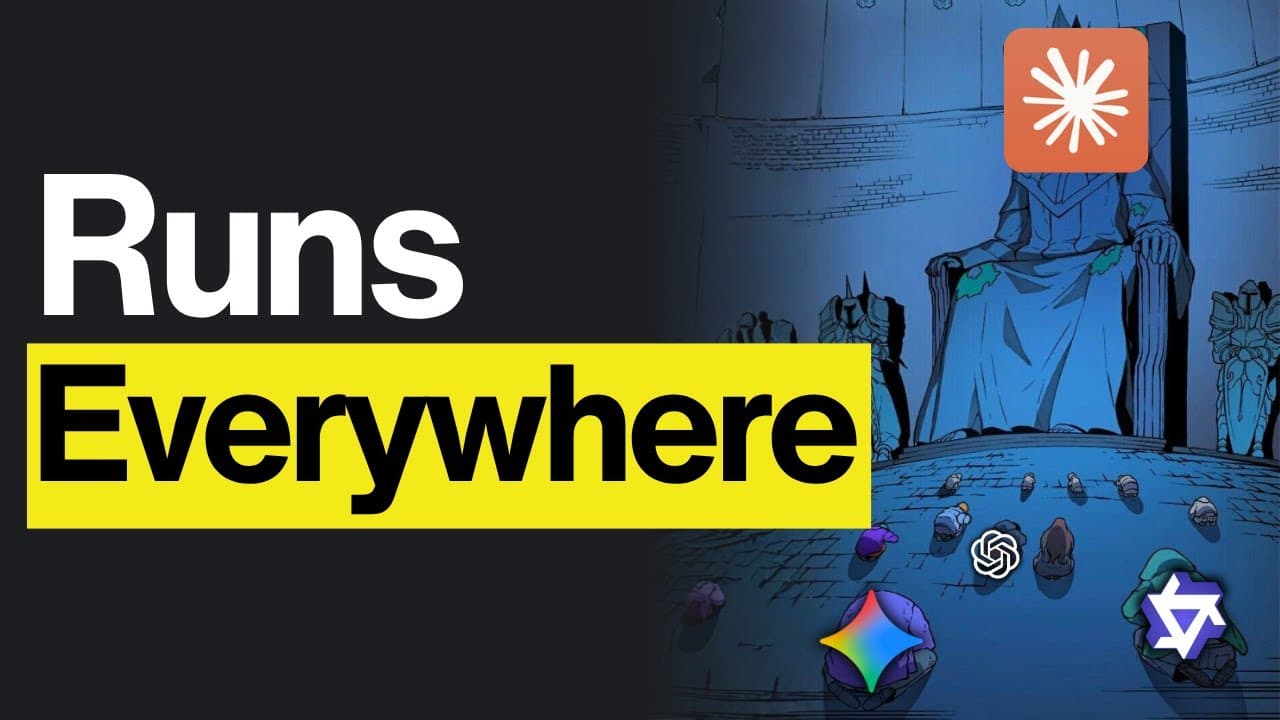
The conclusion reiterates that the move to CLIs is not about limiting interaction to the terminal, but about creating a versatile AI engine that can be exposed across many interfaces. The terminal serves as a friction-free environment for rapid development and iteration of these engines. While users don't have to use the terminal, the speaker suggests that using a model's dedicated CLI often provides the most optimized and performant experience due to the tightly tuned agentic loops. The video predicts a future where these AI engines are widely integrated, enabling "cloud engineering" and making AI capabilities accessible wherever needed.