Detailed Summary
Overview of how autonomous agent loops can handle codebase PRs and content generation overnight.
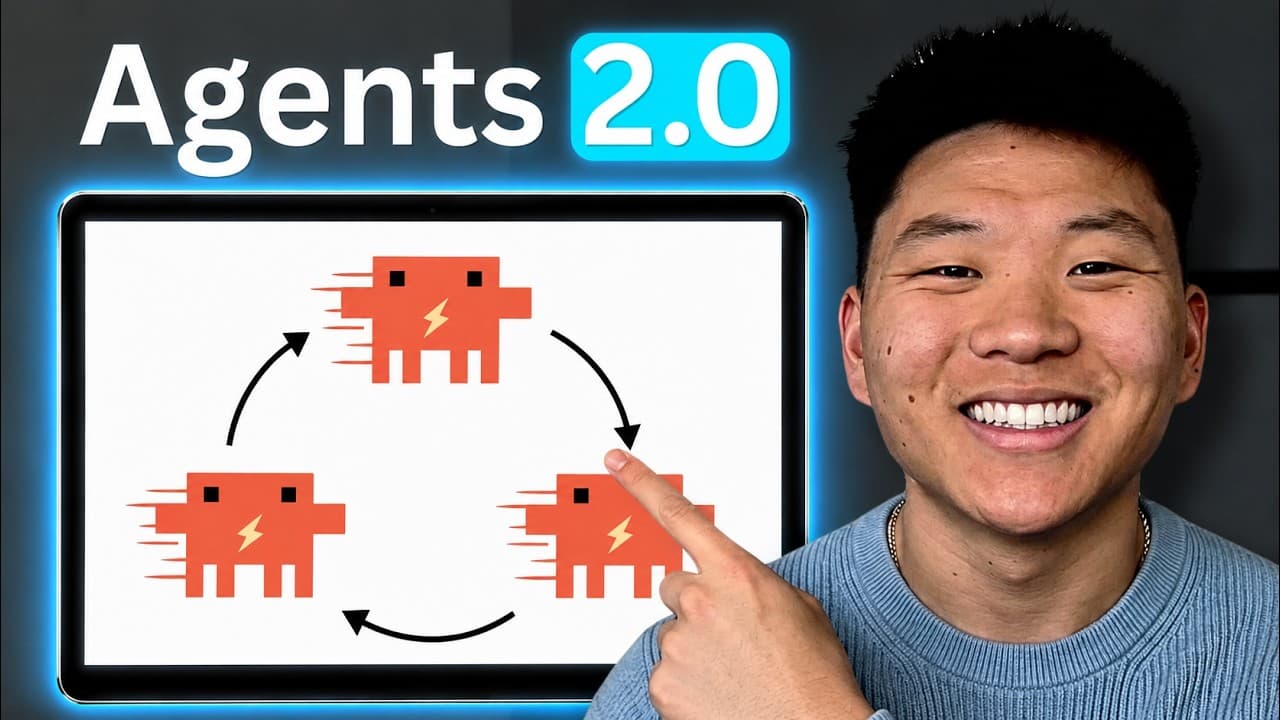
- Introduction of the 'Loop Engineer' concept as the next evolution in AI.
- Explanation that the basic agent pattern consists of a programming language loop, a memory layer, and tool access.
- Mention of HubSpot's free resources for foundational agent building.
Tracing the history of AI interaction from simple completions to complex workflows.
- 2023: Prompt Engineering focused on task completion and steering undeterministic outputs.
- Mid-2024: Expanded context windows (128k to 1M tokens) led to tool-use and 'skills' to manage complexity.
- Late 2025/2026: The rise of cross-session work where multiple agents handle long-running tasks via a shared state or file system.
Defining the Agent Harness (04:46 - 07:08)
The 'harness' is defined as everything in an AI system that is not the model itself.
- Optimization occurs in two places: the agent loop (task completion) and the environment (deciding what to work on).
- Loop engineering frees the user from manual prompting by using triggers like Cron jobs, webhooks, or other agents.
- Example: A support loop that wakes up every 30 minutes to handle tickets and log product frictions.
Compounding Business Loops (07:09 - 09:08)
How multiple autonomous loops interact within a single company to create a 'shared brain.'
- Support Loop: Logs 'signals' (user frictions) into a shared folder.
- SEO Loop: Analyzes data and identifies conversion gaps, reading from the same signal folder.
- Ads Loop: Feeds high-performing keyword data back to the SEO loop for organic content prioritization.
- This structure allows different departments' AI agents to collaborate through a shared file system.
Core Components of Loop Engineering (09:09 - 12:52)
Four essential ingredients for setting up a compounding loop system.
- Triggers: Setting up the scenarios that 'wake up' the agent.
- Legible Codebase: Using
agents.md files and programmatic link checks to guide agents through complex repos.
- Executable Environment: Ensuring agents can spin up local servers with a single command (e.g.,
dev.local) without consuming excessive tokens.
- Verifiable Work: Providing agents with tools like Playwright CLI to record video evidence of their work for human review.
File Structure and Logging Best Practices (12:53 - 15:56)
Effective abstraction levels for agent memory and coordination.
- Artifacts: Shared knowledge layers (Docs, Signals, Tasks) with clear schemas and metadata.
- Contracts: A
README.md for each loop defining its goal, workflow, boundaries, and timeline.
- Global Work Logs: A central
worklog.md where agents record major actions and read recent entries to maintain cross-domain awareness.
Practical Setup: The Support Loop (15:57 - 20:03)
A step-by-step walkthrough of implementing a support loop.
- Integration of skills: Intercom (tickets), Stripe (payments), Supabase (database), and Render (logs).
- Creating an
architecture.md to define conventions for the agent to follow.
- Running a 'test run' to calibrate the agent's workflow before automating the hourly Cron trigger.
- Introduction of a repository template for users to clone this 'Loop Engineer' structure.