Detailed Summary
Introduction and Elad Gil's Journey into Tech (0:00 - 5:22)
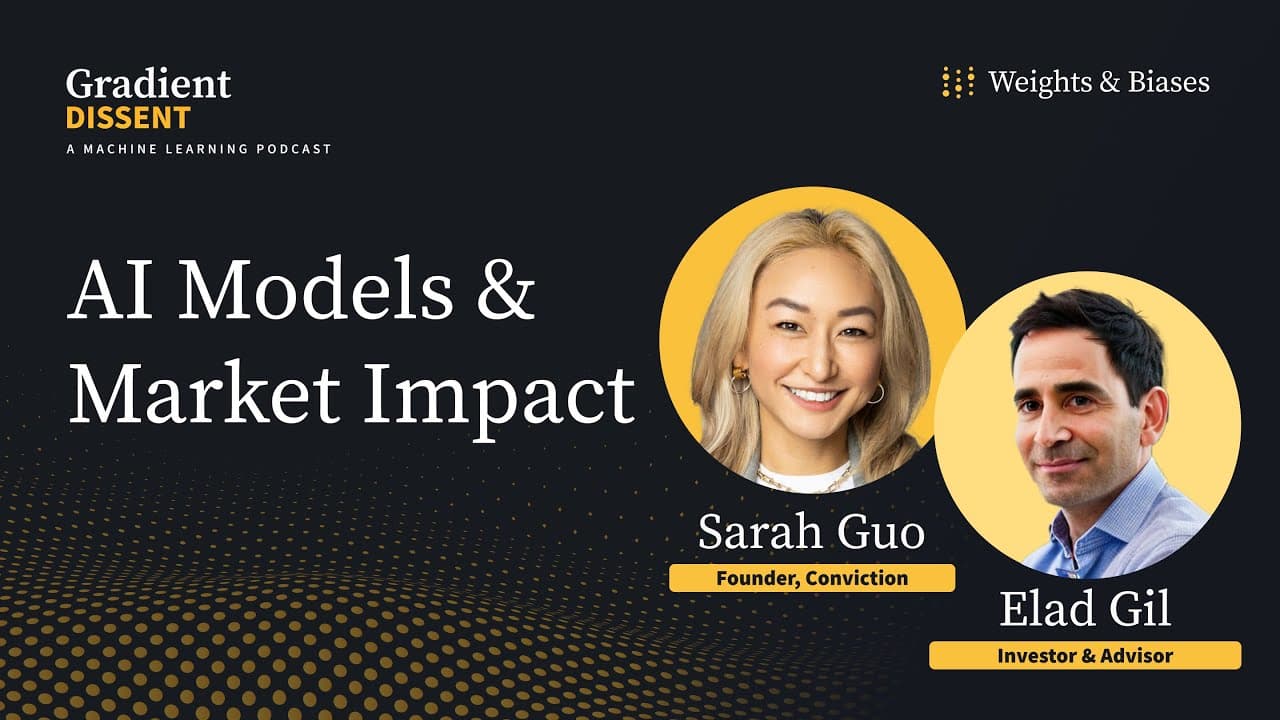
Garry Tan introduces Sarah Guo and Elad Gil, two prominent Silicon Valley investors. Elad Gil recounts his move to Silicon Valley in 2001, coinciding with the dot-com bubble collapse. He describes the challenging environment, including layoffs and a scarcity of jobs, leading him to volunteer for startups to gain experience. This eventually led to a connection with Sequoia Capital and Google, where he worked on mobile and early AI systems. He emphasizes the importance of building strong relationships and joining companies that aggregate talent, as these networks prove invaluable over a career.
- Elad Gil moved to Silicon Valley in 2001 during the dot-com bust.
- He experienced multiple layoffs and a difficult job market.
- He volunteered for startups to gain experience.
- A connection through Sequoia Capital led him to Google, where he worked on mobile and early AI.
- He stresses the long-term value of professional relationships and talent-dense environments.
Sarah Guo’s Journey into Tech (5:22 - 10:38)
Sarah Guo shares her background as the child of immigrant engineers who built a tech company. She grew up around technology, building Linux computers at a young age. After her parents faced financial setbacks post-dot-com bubble, they ventured into startups. Sarah's early exposure to the investing ecosystem was negative, but she developed a fundamental interest in startups. She briefly worked at Goldman Sachs to learn business before moving to Greylock Partners, drawn by the opportunity to work on 0-to-1 projects and the emerging AI space.
- Sarah Guo's parents were engineers who built a tech company.
- She had early exposure to technology and startups.
- She worked at Goldman Sachs for a year to gain business knowledge.
- She joined Greylock Partners, focusing on early-stage company building and AI.
- She advises focusing on genuinely interesting areas, as intuition can lead to future success.
Both investors discuss their initial significant investments. Elad Gil's early investments were organic, helping friends who were also founders, leading to investments in companies like Airbnb, Optimizely, and Minted. He notes that early investment success can be identified relatively quickly, contrary to popular belief. Sarah Guo highlights her Series A investment in Figma with John Lily. She explains that while the market case for Figma was initially complex, the conviction was in the founders, Dylan Field and Evan Wallace, and the long-term vision for web-based design tools. They both reflect on how difficult it is to predict the true scale of a successful company early on, citing how estimates for Stripe and Square were vastly underestimated.
- Elad Gil's early investments were organic, supporting friends' ventures.
- His portfolio included early investments in Airbnb, Optimizely, and Minted.
- Sarah Guo's significant early investment was the Series A in Figma.
- They emphasize investing in exceptional founders with a long-term vision.
- They acknowledge the difficulty of predicting the eventual scale of successful tech companies.
Characteristics of Great Founders (17:20 - 21:51)
The conversation shifts to identifying traits of successful founders. Elad Gil points to polymathic interests as a positive sign, indicating a founder's ability to broaden their understanding beyond technical aspects to include commercial and business insights. Sarah Guo adds that great founders are adept at leveraging help and seeking excellence in all dimensions, citing Dylan Field's ability to learn and utilize support. Both agree on the importance of intellectual honesty—founders who acknowledge what isn't working rather than rewriting narratives. Elad Gil also re-emphasizes the often-undervalued traits of raw hard work, aggression, and a willingness to prioritize the startup above all else, especially evident in many AI founders today.
- Polymathic interests are a strong indicator of a founder's potential for broader understanding.
- Successful founders are skilled at utilizing help and striving for excellence.
- Intellectual honesty and self-awareness are crucial traits.
- Raw hard work, aggression, and dedication to the startup are essential, particularly in the current AI landscape.
The Future of AI Investment (21:51 - 26:17)
Looking at the current AI market, Sarah Guo and Elad Gil discuss their investment strategies. Sarah Guo looks for founders with deep curiosity, product taste, an understanding of the frontier, and a longitudinal perspective to predict future trends. She highlights the importance of preserving the velocity and aggressive culture seen in successful AI companies. Elad Gil admits that his predictive ability in AI is limited due to the market's rapid changes, where "every week is a year." He focuses on identifying interesting markets, defensibility, and great founders. He points to the massive potential for AI to transform industries, estimating that converting just 10% of the $5 trillion services market (currently headcount-driven) into SaaS spend could recreate the entire US SaaS market. He also mentions AI-driven buyouts as a new area of interest. Both agree that while luck plays a role, founders must focus on building, shipping, and engaging with users.
- Investors seek founders with curiosity, product taste, frontier understanding, and predictive ability in AI.
- The AI market is rapidly changing and highly unpredictable.
- AI has the potential to convert a significant portion of the $5 trillion services market into SaaS.
- New investment areas include AI-driven buyouts.
- Despite market complexity, the core advice for founders remains: talk to users, build, and ship product.