Detailed Summary
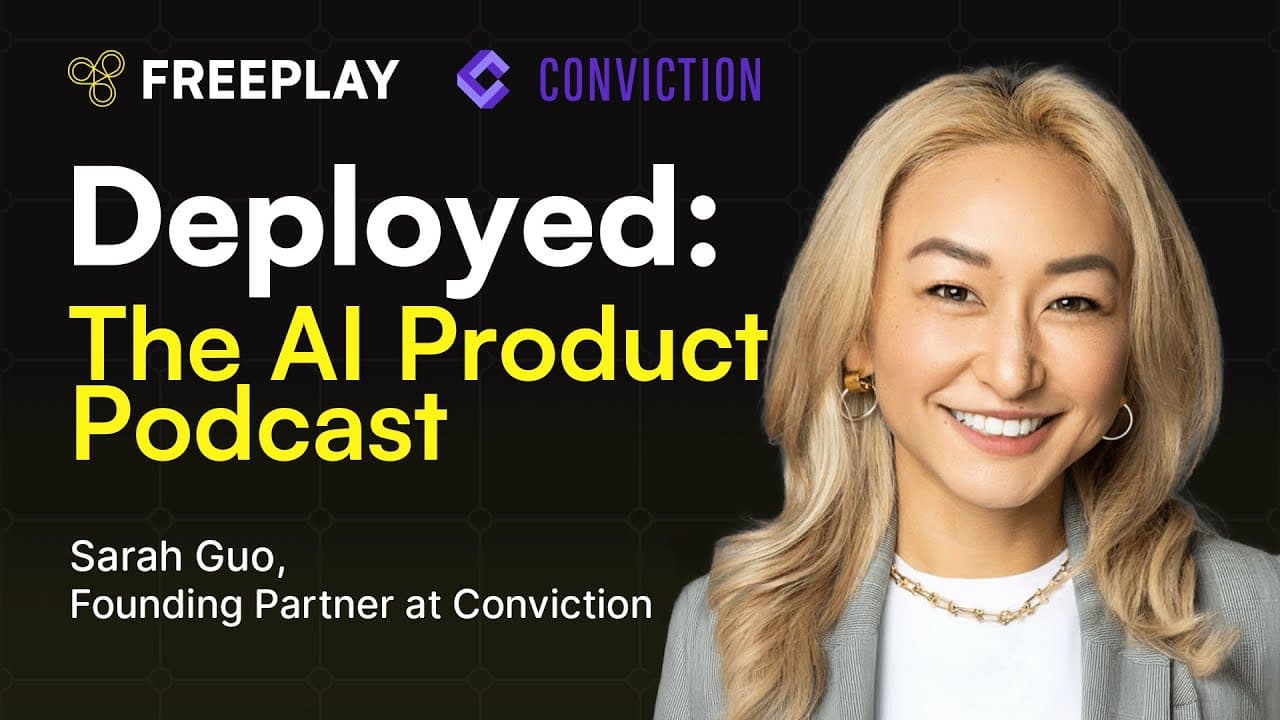
Lukas Biewald introduces Sarah Guo and Elad Gil, prominent AI investors and co-hosts of the No Priors podcast. Sarah Guo shares her method for staying current with LLM research, which is largely driven by portfolio company needs and a paper reading group. She highlights her interest in code generation (CoGen) and self-debugging papers from MIT, Microsoft Research, and DeepMind, noting its potential for democratizing software development.
Exploring Fine-Tuning vs RAG in AI (5:15 - 10:30)
Elad Gil discusses how CoGen is unique, being several years ahead of other AI applications due to its language-based, highly ordered logic, making it more tractable for LLMs. He suggests this might create an inflated perception of AI's overall progress. Sarah Guo agrees that generating software is an exciting general-purpose tool, but questions whether future generations will need to learn traditional coding skills, emphasizing the enduring importance of debugging and architectural understanding. They both agree that many CoGen companies are overly focused on research rather than shipping practical products, and that much could be achieved with existing models like GPT-4.
Evaluating AI Research for Investment (10:30 - 15:45)
The discussion shifts to AI's impact on the broader economy, noting that $500 million is spent on software annually compared to $5 trillion on services. Elad posits that AI's revolution will primarily target these service industries, automating tasks in consulting, legal (e.g., Harvey), and accounting. Sarah adds that AI can disrupt areas of engineering that are repetitive or involve high maintenance burdens, such as integrations, migrations, and internal tools, which currently protect large, ingrained businesses. They consider the future of companies like Zapier, acknowledging their proactive AI adoption while recognizing the risk posed by reduced costs of point-to-point integrations.
Impact of AI Models on Product Development (15:45 - 20:00)
Elad Gil notes that companies with technical founders or product-centric approaches, like Zapier and Notion, have been the fastest to adopt AI. He points out that while ChatGPT's launch was a wake-up call, enterprises are still in early planning stages, suggesting the full impact is years away. He proposes a rule of thumb: incumbents win if AI enhances existing workflows, while startups thrive on new workflows or rip-and-replace opportunities. Sarah Guo highlights the rapid success of creative AI products like Midjourney, Pika, and HeyGen, expanding the definition of "creatives" and demonstrating significant commercial viability beyond initial skepticism.
AI's Role in Evolving Job Markets (20:00 - 25:15)
Sarah and Elad discuss how creative AI tools are already impacting enterprise use cases, with some organizations shrinking internal creative teams due to tools like Midjourney. They observe a pattern of bottom-up adoption in AI, similar to Slack and Zoom, which eventually transitions to traditional enterprise sales. Lukas Biewald questions if compelling demos always translate to explosive growth. Sarah points out that many sophisticated CoGen tools, beyond GitHub Copilot, are not yet broadly adopted due to reliability issues in production environments. Elad draws a parallel to the 1990s tech demos, where future concepts were clear but the underlying technology wasn't ready for widespread use.
The Balance Between AI Research and Product Development (25:15 - 30:00)
Elad Gil compares the AI hype cycle to blockchain's three hype cycles, noting that technology often follows similar waves of excitement and subsequent corrections. He emphasizes that blockchain applications need to be driven by its core capabilities (trustlessness, encryption) rather than just being a "shitty database." He warns that excessive hype can delay technological progress, citing the payments industry's stagnation after early fraud issues. Sarah Guo agrees, highlighting the confusion between speculation and genuine technological advancement in crypto, which she believes is less prevalent in AI due to less pure speculation.
Code Generation Technologies in Software Engineering (30:00 - 35:00)
Elad speculates on a future where AI agents, representing individuals or services, interact programmatically, potentially leveraging blockchain for secure, anonymous identity and cryptographic credentials. He also mentions crypto as a potential payment rail for AI, though he notes traditional banking could serve a similar purpose. The conversation then shifts to the high valuations of AI companies, particularly foundational models. Sarah attributes this to the "OpenAI and Nvidia effect," where examples of exponential growth drive a stampede towards market leadership in what appears to be a new, oligopolistic stack.
AI's Broader Industry Implications (35:00 - 40:00)
Elad explains that value creation follows a power law, with a small number of companies capturing most of the value. He cautions that while top companies might seem overpriced at the time of investment but cheap in hindsight (like Facebook), most companies won't achieve such scale. He notes that the COVID-era inflated valuations, creating an overhang of overvalued companies. Sarah adds that if AI represents a fundamental market shift, there's a limited window for new market leaders to emerge before it becomes too difficult to compete with established players.
Importance of Product-Driven Approaches in AI Startups (40:00 - 45:00)
Elad suggests that for investors, waiting to invest in later-stage, proven companies might be a viable strategy, citing the massive growth of tech giants like Microsoft and Nvidia in recent years. Sarah acknowledges the high capital requirements for training foundational models but argues that most companies should prioritize productization and workflow integration over training models from scratch. She emphasizes that venture capital traditionally values capital-efficient growth.
AI in Various Sectors: Beyond Software Engineering (45:00 - 50:00)
Elad segments AI opportunities by stack (infra, tooling, applications) and model type (diffusion vs. LLM). He notes that application-layer companies are often more capital-efficient. Diffusion models are cheaper to train than LLMs, making self-training more feasible for image/video applications where fidelity requirements are lower. For LLMs, while some specific use cases warrant custom training, many can effectively use GPT-4, with a trend towards fine-tuning smaller models like Llama or Mistral for cost and performance optimization.
Open Source vs Proprietary AI Models (50:00 - 55:00)
Elad and Sarah discuss the trend of large enterprises prototyping on GPT-4 and then optimizing for cost and performance by fine-tuning smaller, open-source models or using orchestrators to route traffic. Sarah highlights that products like Descript use a diverse family of models for different features, balancing latency, cost, and control. While open-source models like Mistral offer cost advantages at high volumes, the total cost of ownership can be higher for smaller companies. They anticipate infrastructure solutions (like Perplexity's APIs or AI proxies) will simplify access to diverse models, making it easier for companies to leverage them without extensive MLOps teams.
AI's Impact on Traditional Roles and Industries (55:00 - 1:00:00)
Sarah and Elad debate the long-term trajectory of open-source versus closed-source models. Sarah believes the market won't be deterministic, citing examples like Grafana (open-source) and Datadog (proprietary) coexisting. She argues that open-source alternatives gain traction when proprietary vendors behave poorly or when there's significant ecosystem investment. Elad, needing to leave, poses a final question about underrated aspects of machine learning.
Elad suggests that ML could be used for fraud detection in scientific research, identifying common patterns of data manipulation. He also points to memory and mathematical/scientific understanding as important non-application areas for ML. Sarah Guo identifies operational understanding of workflows, particularly those with high toil and repetitive knowledge work, as an underrated area. She gives examples like on-call incident resolution (analyzing dashboards, writing queries), security operations, HR (answering policy questions), and corporate FP&A (explaining budget variances), all of which could be highly automated to free up teams for more strategic tasks.