Detailed Summary
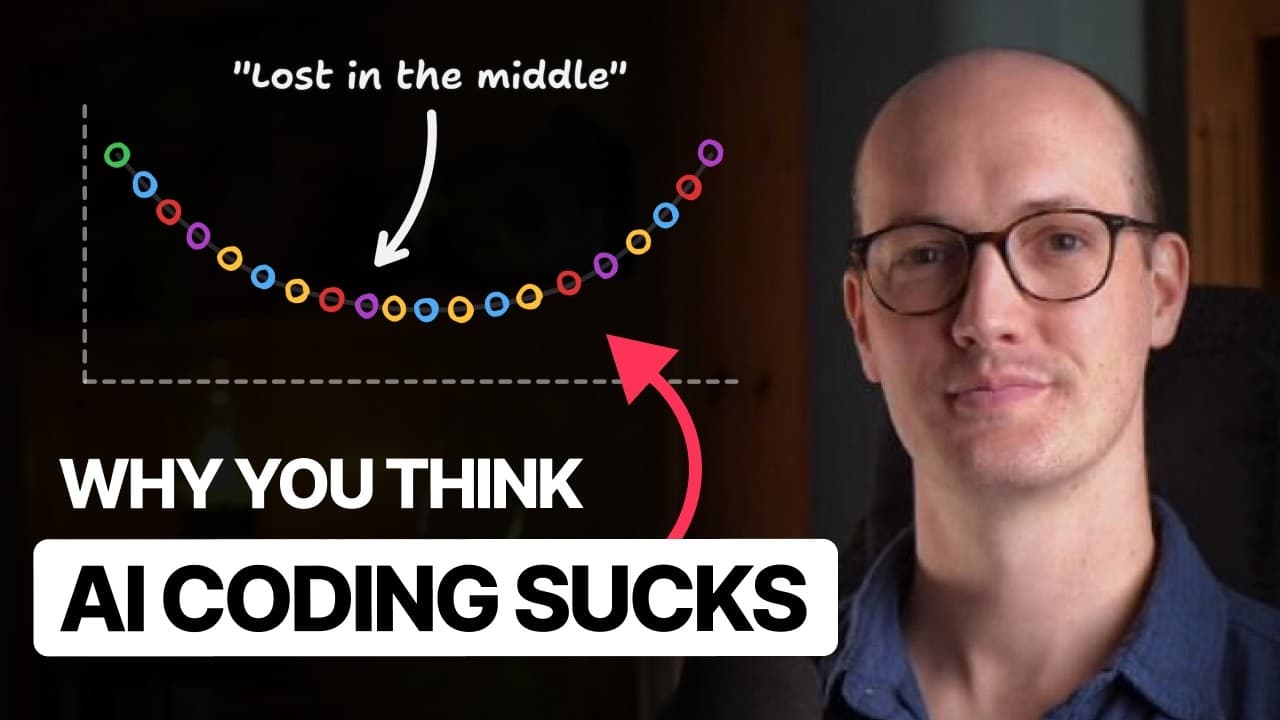
MIT's new paper introduces Recursive Language Models to address the industry-wide issue of context rot. While models claim large context windows, their actual utility drops significantly after 100k tokens. RLMs aim to push this boundary to 10 million tokens.
Comparing base GPT-5 to the RLM-enhanced version reveals a massive performance gap.
- Needle in a Haystack: Both models perform well on simple retrieval tasks.
- Olong Tasks: These require finding complex combinations within data. As context grows, the base model's performance hits zero at its 272k limit, while the RLM remains stable up to 1 million tokens.
- Massive Scaling: On the 'Browse Comp' test involving 11 million tokens (40x the base window), the RLM scored 91% while the base model failed completely.
The RLM system functions by treating a prompt as a variable in a Python REPL environment rather than direct input.
- Reconnaissance: The model writes Python code to 'peek' at the document (e.g., checking character length or identifying chapter headers).
- Smart Chunking: By identifying where specific information (like a character name) exists via code, the model avoids loading irrelevant text.
- The Recursive Layer: The primary LLM acts as a manager, spawning sub-agents (e.g., GPT-5 Mini) via tool calls to process specific chapters or sections.
- LLMs All the Way Down: This process can be multi-layered; if a sub-chunk is too large, the sub-agent can spawn its own sub-agents to further divide the work.
The paper concludes that long prompts should be treated as part of the 'environment' the LLM interacts with symbolically.
- Information Density: RLMs provide strong benefits for dense inputs where cross-referencing is required.
- Workflow Integration: The speaker suggests that users of 'sub-agents' in tools like Claude are already using the fundamental logic of RLMs.
- Future Direction: This research aligns with other emerging trends like GSD and Ralph loops, focusing on context window management as the next frontier of AI output quality.