Detailed Summary
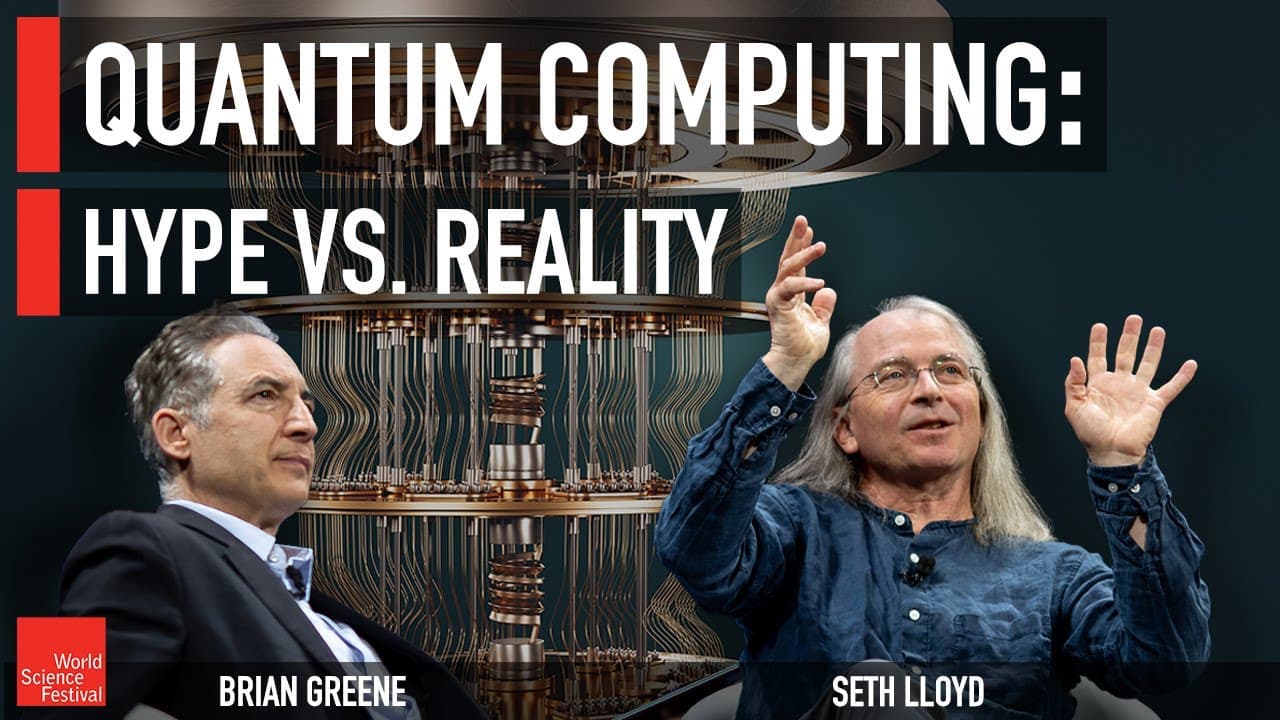
The video opens with a lighthearted discussion about snacks, transitioning into the main topic of quantum computing. The host introduces Ginger Bill, a quantum physicist, and other panelists to discuss recent breakthroughs, specifically Google's paper on verifiable quantum algorithms and "quantum echoes," and to clarify what these advancements truly mean for practical applications.
- The discussion is prompted by Google's recent paper on "quantum echoes" using a 105-qubit chip.
- The goal is to understand the practical implications of quantum computing and demystify sensational articles.
- The host questions if quantum computers are still primarily factoring small numbers like 21.
Intro to Quantum, Qubits, and Superpositions (2:46 - 7:20)
Ginger Bill begins by explaining the fundamental difference between classical bits and quantum qubits. Classical bits store either a 0 or a 1, while qubits can exist in a superposition of both states simultaneously, illustrated with the analogy of waves in a pond.
- Classical computers use binary bits (0 or 1), storing one state at a time.
- Qubits (quantum bits) can be in a superposition of both 0 and 1 states.
- Superposition is analogous to waves interacting and adding together, creating a new wave.
- A qubit's state is described by probabilities, e.g., a 40% chance of being 0 and a 60% chance of being 1.
The concept of entanglement is introduced, where two qubits become intrinsically linked, meaning their states are inseparable. This allows multiple entangled qubits to represent all possible states simultaneously with varying probabilities, significantly increasing computational power.
- Entanglement means two quantum states are intrinsically linked and inseparable.
- Unlike superposition, entanglement is a uniquely quantum phenomenon.
- Two entangled qubits represent all four possible states (00, 01, 10, 11) simultaneously with specific probabilities.
- Adding more qubits exponentially increases the number of states represented, with 300 qubits potentially representing more states than atoms in the universe.
Shor's algorithm is highlighted as a key quantum algorithm that demonstrates a significant advantage over classical computing. It can efficiently factor large integers into their prime components, a task that is computationally intensive for classical computers.
- Shor's algorithm is a well-known quantum algorithm for factoring integers into prime components.
- It can perform this task in polynomial time (proportional to log n), making it much faster than classical algorithms.
- This capability has significant implications for cryptography, as many encryption methods rely on the difficulty of prime factorization.
Interference and Decoherence (12:07 - 14:31)
Ginger Bill explains the critical challenges of interference and decoherence in quantum systems. Quantum computers must operate at extremely low temperatures to minimize external noise, which can cause qubits to lose their quantum properties and collapse into classical states.
- Quantum computers require extremely cold temperatures (near absolute zero) to prevent background noise from interfering with qubits.
- Noise makes probabilistic results even more uncertain and can render computations useless.
- Interference can be constructive (amplifying probabilities) or destructive (canceling them out), similar to wave interactions.
- Decoherence is the process where a quantum state collapses into a classical state, effectively losing its quantum properties.
The discussion addresses the inherent fragility of quantum systems. The need for extreme cold is explained as a way to reduce the "jiggliness" (thermal energy) of atoms, which can disrupt quantum states. This process involves using lasers to slow down atoms, akin to shooting ping-pong balls at an elephant.
- Quantum systems are incredibly fragile due to their sensitivity to environmental noise.
- Cooling atoms to extreme temperatures reduces their "jiggliness" or thermal motion.
- This cooling process often involves using lasers (photons) to slow down atoms.
Heisenberg's Uncertainty Principle (17:00 - 18:03)
The Heisenberg Uncertainty Principle is introduced to explain why absolute zero cannot be reached. It states that there's a fundamental limit to the precision with which certain pairs of physical properties, like position and momentum, can be known simultaneously. Trying to precisely measure one makes the other inherently uncertain.
- Absolute zero is unattainable due to the Heisenberg Uncertainty Principle.
- This principle states that precisely measuring one property (e.g., position) makes another related property (e.g., momentum) inherently uncertain.
- This fundamental uncertainty is present even in macroscopic measurements, not just at the quantum level.
The conversation briefly veers off-topic, discussing whether quantum computers could explode (yes, due to lasers), the invention of the microwave, and the dangers of radon gas, before returning to the core subject.
- Quantum computers can pose hazards due to powerful lasers used in their operation.
- The invention of the microwave oven is humorously linked to accidental scientific discovery.
- Radon gas, a naturally occurring radioactive element, is mentioned as a health concern in certain areas.
Magnetic Field Aim Assist (20:16 - 22:34)
Magnetic fields are explained as a crucial component in quantum computing, acting as an "aim assist" for lasers. They help make atoms more receptive to specific frequencies of photons, facilitating the precise manipulation of quantum states.
- Strong magnetic fields are used to manipulate atoms in quantum computers.
- They make atoms more susceptible to absorbing specific frequencies of photons, acting as an "aim assist."
- Early quantum computers sometimes used MRI-like technology, employing massive magnets and radio waves.
Quantum Gates & Basis Vectors (22:34 - 30:48)
The discussion moves to quantum gates, which are the operational units of quantum computers, analogous to logic gates in classical computing. These gates perform transformations on qubits, often involving linear algebra and matrix operations, such as rotating basis vectors (e.g., Hadamard gate) to manipulate probability distributions.
- Quantum gates are the operational units, similar to classical logic gates (AND, OR, NOT).
- They perform transformations on qubits, often represented by matrices.
- The Hadamard gate, for example, changes the basis vectors, effectively rotating the quantum state.
- The goal is to manipulate probability distributions to increase the likelihood of desired outcomes.
Quantum Algorithms and Passwords (30:48 - 37:50)
Panelists discuss how quantum algorithms work, emphasizing that they don't instantly provide answers but rather manipulate probability distributions. Through multiple runs and statistical analysis, quantum algorithms can filter out incorrect answers and amplify correct ones, leading to a higher probability of finding the solution much faster than classical methods.
- Quantum algorithms don't provide instant answers but manipulate probability distributions.
- They work by making desired outcomes more probable and undesired outcomes less probable.
- Multiple runs are often needed to "clean up" noisy results and converge on the correct answer.
- This process is compared to an audio equalizer, filtering out unwanted frequencies and amplifying desired ones.
The Heisenberg Uncertainty Principle is revisited, clarifying that uncertainty is a fundamental aspect of measurement in the real world, not just a quantum phenomenon. The analogy of children acting differently when observed is used to illustrate how observation affects quantum states.
- Uncertainty is intrinsic to all measurements, not exclusive to quantum mechanics.
- The precision of a measurement tool dictates the inherent error or uncertainty.
- The act of observation fundamentally changes quantum states, similar to how children behave differently when watched.
What are people planning on using this for (40:15 - 42:41)
The primary motivations for quantum computing research are discussed, including breaking encryption (e.g., RSA) and developing new forms of encryption that are quantum-safe. Other applications involve complex search problems, such as "quantum walks," which can be significantly faster than classical random walks.
- Key applications include breaking existing encryption (like RSA) and developing quantum-safe encryption.
- Quantum computers excel at complex search problems, such as "quantum walks."
- These quantum algorithms can perform certain searches much faster than classical methods.
Google's "Willow chip" is discussed, with the consensus being that it is likely a single-purpose chip designed for specific tasks, rather than a general-purpose quantum computer. This implies that each new problem might require a custom-designed quantum chip or significant reprogramming.
- The Google Willow chip is likely a single-purpose chip, optimized for specific algorithms.
- This means new problems may require custom chip designs or extensive reprogramming.
- These chips operate at extremely cold temperatures (less than 20 millikelvins).
Quantum Programming Languages (44:33 - 48:41)
Panelists explore the state of quantum programming languages, noting that they are currently at an "assembly level," requiring direct construction of quantum circuits rather than high-level coding. The analogy is drawn to early computing where programmers directly wrote machine code, highlighting the immaturity of quantum software development.
- Quantum programming languages are currently at an "assembly level," focusing on constructing quantum circuits.
- They lack the high-level abstractions found in classical programming languages like C or Python.
- This is compared to early computing where programmers directly wrote machine code.
The specific Google paper on "quantum echoes" is mentioned again, with its complex title and the term "erodicity." Ginger Bill clarifies that "erodicity" refers to a system eventually covering all points in a given abstract space, similar to a drunk man eventually covering an entire field.
- The Google paper's title, "Observation of constructive interference at the edge of quantum erodicity," is noted for its complexity.
- "Erodicity" means a system will eventually visit all possible states or points in its abstract space.
- This concept is likened to a drunk man eventually covering every spot in a field.
TrashDev shares his simplified notes on quantum computing, which include "superposition," "entanglement," "can't be both values at once," and "has to be cold." These notes are acknowledged as surprisingly accurate and a good starting point for understanding the basics.
- TrashDev's simplified notes capture key quantum concepts: superposition, entanglement, and the need for extreme cold.
- These basic points are considered essential for understanding quantum computing articles.
Mapping Proteins and Other Uses for Quantum Computing (52:07 - 55:37)
One of the most promising applications of quantum computing is mapping the shapes of molecules, particularly proteins. This is crucial for drug discovery, as a molecule's 3D structure dictates its function. Quantum algorithms can efficiently search for optimal molecular orientations, potentially accelerating medical research.
- Quantum computers are valuable for mapping molecular shapes, especially proteins.
- Understanding 3D molecular structure is vital for drug discovery and medicine.
- Quantum algorithms can efficiently search for the lowest energy configurations of molecules.
- This is a complex search problem where quantum computing offers a significant advantage.
The Google "quantum echoes" paper is further explained as an algorithm focused on scrambling and unscrambling data. It reportedly performs this task 13,000 times faster than the largest supercomputer, demonstrating quantum supremacy for this specific problem. However, this speed advantage is limited to the particular algorithm it was designed for.
- "Quantum echoes" involves scrambling and unscrambling data.
- This specific algorithm was reportedly 13,000 times faster than the largest supercomputer.
- The speed advantage is specific to this algorithm and not generalizable to all problems.
The Future of Quantum Computing (58:20 - 1:05:19)
The commercial viability and accessibility of quantum computing are discussed. It's suggested that widespread personal quantum computers are decades away, with current systems likely remaining in specialized facilities. The government's push for quantum-safe encryption by 2025-2028 raises questions about their current capabilities.
- Widespread commercial application of quantum computers is likely decades away.
- Future accessibility might depend on advancements in photonic-based or room-temperature superconductor quantum computers.
- Government mandates for quantum-safe encryption by 2025-2028 suggest they may already possess advanced quantum technology.
- The idea of "quantum AI" is dismissed as a marketing buzzword, with no current practical meaning.
Quantum AI is a lie tell Facebook (1:05:19 - 1:08:09)
The term "quantum AI" is debunked as a marketing gimmick, combining two complex terms without real substance. While AI involves matrix multiplication and probability distributions, similar to quantum mechanics, the current state of quantum computing does not support a practical "quantum AI."
- "Quantum AI" is largely a misleading term, combining two complex concepts for sensationalism.
- AI's use of matrix multiplication and probability distributions has some conceptual overlap with quantum mechanics.
- However, current quantum computing capabilities do not enable practical "quantum AI."
The host thanks Ginger Bill for his insights, concluding that many sensational articles about quantum computing are likely exaggerated for the next decade. The panelists promote their social media and courses, ending the discussion on a humorous note about personal Facebook history.
- Many sensational claims about quantum computing are likely overblown for the foreseeable future.
- The panelists promote their work and social media.
- The discussion ends with a humorous anecdote about old Facebook posts.